You know that website that seems to rank for everything?
You search for a question about their industry, and there they are. Search something slightly more specific, and yep, there they are again. Click through to their site and suddenly you realize they have a web page for practically every question you’ve ever had.
Coincidence? Probably not.
One of the strategies behind that kind of consistent organic visibility is content clusters SEO.
Instead of publishing blog posts whenever inspiration strikes and hoping Google connects the dots, a content cluster strategy organizes your website around the topics you actually want to be known for.
When your content is organized, interconnected and genuinely useful, you’re giving both your audience and search engines a much clearer picture of your expertise.
So, if your company’s blog currently looks a little like a junk drawer of random topics, it’s time to get organized.
What Is a Content Cluster?

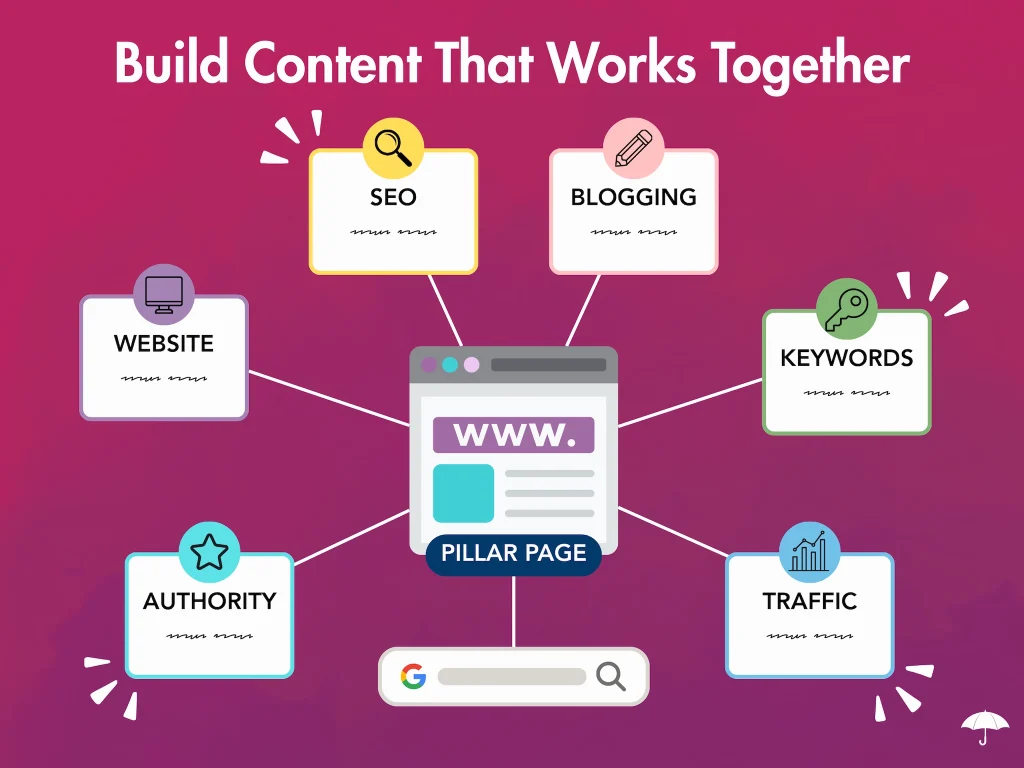
A content cluster is a group of related pieces of content built around one broad topic.
At the center is a comprehensive pillar page that covers the main subject. Supporting blog posts then dive deeper into specific questions, subtopics and related issues.
This is sometimes referred to as clustered content because the individual pieces are grouped around a central subject rather than existing as completely separate pages on your site.
Think of it like this:
Pillar page: Website Design Services
Supporting content might include:
- How Much Does a Website Cost?
- What Pages Should a Business Website Have?
- How Long Does It Take to Build a Website?
- Website Design vs. Website Templates
- How to Know When It’s Time for a Website Redesign
- What Makes a Website User-Friendly?
Each article serves a purpose on its own. But together, they create a connected network of content around a central topic.
That’s the magic of content clusters SEO.
You’re not just creating more content. You’re creating content that works together.
Why Content Clusters Matter for SEO

Publishing one blog post about a topic doesn’t automatically make your website an authority on it.
Think about how people actually search. They don’t all type the same thing into Google. Your audience may use dozens of different search queries to find information about the same subject.
One person might search “website design.”
Another might search “how much does a small business website cost?”
Someone else might type “how long does it take to build a business website?”
Those more specific searches can be opportunities to target long tail keywords that address very specific questions or needs.
That’s one reason content clusters can be so useful.
When multiple pieces of high-quality content cover related aspects of a specific topic, you have more opportunities to answer the questions your audience is searching for.
You can also use search volume to help prioritize topics. A broad topic may have a higher search volume, while a more specific long tail keyword may have fewer searches but a much clearer connection to what someone actually wants.
The goal isn’t to chase the biggest number.
It’s to build a collection of useful content that covers the topic thoroughly and serves the people you actually want to reach.
And here’s where internal linking becomes your best friend.
Instead of letting every blog post live on its own little island, you connect related content.
A blog post about website redesign can link to your pillar page about website design. That pillar page can link to your redesign article and other supporting resources. Another related article can link back to both.
Now you’ve created a content ecosystem instead of a pile of blog posts.
Much more useful.
Much less “we published this because it was Tuesday.”
How to Build a Content Cluster Strategy

A successful content cluster strategy doesn’t require you to publish 100 articles overnight.
In fact, please don’t.
The goal is to create a thoughtful structure that supports your business goals, your audience’s questions and your broader SEO strategy.
Here’s where to start.
1. Define Your Content Clusters
First, identify the major topics you want your business to be known for.
These should connect directly to your products or services and the problems your ideal customers are trying to solve.
Start with a broad topic and then break it into more specific subjects.
For example, a marketing agency might develop clusters around:
- SEO
- Content marketing
- Website design
- Social media marketing
- Email marketing
A cybersecurity company might focus on:
- Managed IT services
- Cybersecurity
- Network security
- Data backup
- Employee security training
From there, dig deeper.
What questions does your audience have? What problems do they need to solve? What search queries are they using? Which long tail keywords could help you answer those questions?
Those become your supporting content opportunities.
The result is a more intentional approach to organizing content across your website.
2. Plan the Structure
Once you’ve identified your clusters, map out how the content connects.
Your pillar page should provide a comprehensive overview of the main topic while linking to more detailed supporting content.
A pillar page can also benefit from a table of contents, especially when it covers a broad subject and includes several sections. This helps visitors quickly find the information they’re looking for while making a lengthy page easier to navigate.
Then your supporting blog posts can link back to the pillar page and to other relevant articles when it makes sense.
For example:
Pillar page: Content Marketing
↓
Supporting content:
- What Is Content Marketing?
- How Often Should You Publish Blog Posts?
- Evergreen Content vs. Trending Content
- How to Create a Content Calendar
- How Blogging Builds SEO
- How to Measure Content Marketing Results
This structure creates a clear relationship between your pages.
It also creates more opportunities for visitors to keep exploring your website instead of reading one article and disappearing into the internet abyss.
Don’t Forget Internal Linking
This is one of the easiest pieces of the puzzle to overlook.
You’ve already done the hard work of creating content. Now make sure your content actually talks to itself.
Use internal linking to connect related pages throughout your website.
A good internal link can:
- Help visitors discover related information
- Make your content easier to navigate
- Help search engines understand relationships between pages
- Direct users toward important service or conversion pages
- Strengthen the overall structure of your website
And don’t just slap “click here” onto every link.
Use descriptive anchor text that gives readers and search engines some context about where the link leads.
Your content shouldn’t just exist.
It should connect.
3. Track the Results
Here’s where the strategy gets interesting.
A content cluster isn’t something you build once, cross your fingers and forget about.
You need to watch what happens.
Track things like:
- Organic traffic
- Search rankings
- Search impressions
- Click-through rates
- Organic conversions
- Engagement with supporting content
- Which topics generate the most interest
- Which pages attract visitors from organic search
- Changes in bounce rate
Your website’s performance in the search engine results page, or SERP, can tell you a lot about how your content strategy is performing.
You may discover that one topic is bringing in significantly more traffic than another.
Great. That’s useful information.
You can expand that cluster with additional content, update existing articles, strengthen internal links or create new resources around questions your audience is searching for.
You may also discover that a page ranking for a handful of long tail keywords has become an unexpected traffic driver. That’s a signal worth paying attention to.
SEO isn’t a “set it and forget it” marketing tactic.
It’s a process of creating, measuring, learning and improving.
Your Blog Doesn’t Need More Content. It Needs More Strategy.
Here’s a common problem we see with business websites:
Lots of content. Little organization.
Maybe someone wrote five blog posts about SEO.
Someone else wrote three about websites.
Someone wrote an article about email marketing two years ago.
Then another person published something about SEO six months later.
And nobody connected any of it.
The content may be perfectly good. But without a larger strategy, you’re making Google and your visitors work harder to understand how everything fits together.
That’s where content planning becomes just as important as content creation.
Organizing content into logical clusters gives individual web pages a larger purpose. Instead of each article competing for attention on its own, related pages can support one another.
You don’t necessarily need to publish more.
You need to publish with purpose.
Content Clusters vs. Random Blogging
Let’s be honest: Random blogging is easy.
Someone on the team says, “We haven’t published a blog in a while.”
Someone else throws out an idea.
A writer puts together 1,200 words.
It gets published.
Everyone moves on.
Until three months later when someone asks, “Wait… didn’t we already write about this?”
A cluster strategy changes that process.
Instead of starting with “What should we blog about this week?”, you start with:
“What topics do we need to establish authority around?”
Then you can build a content roadmap around those topics.
That roadmap can identify your pillar pages, supporting articles, long tail keyword opportunities, internal links and future content updates.
Now your blog isn’t just a collection of articles.
It’s part of your SEO strategy.
Should You Handle Content Strategy In-House?
If you have a marketing team with the time, SEO knowledge and writing resources to develop and maintain a content strategy, absolutely.
Your team knows your industry. They know your customers. They know your brand voice.
But there’s a catch.
Content marketing takes time.
Research takes time. Keyword research takes time. Writing takes time. Updating old content takes time. Building internal links takes time. Reviewing analytics takes time.
And suddenly your marketing team is spending Tuesday afternoon debating whether a blog should be 1,200 or 1,500 words.
Meanwhile, someone still needs to answer the emails.
That’s where bringing in an agency can make sense.
When It’s Time to Bring in an Agency
You don’t have to choose between having an in-house marketing team and outsourcing everything.
An agency can work alongside your existing team to fill the gaps.
At Raney Day Design, we can help businesses develop a content strategy that’s connected to their broader SEO and website goals.
That can include identifying content opportunities, organizing topics into clusters, developing pillar pages, creating supporting blog content and building an internal linking strategy that makes the whole site work harder.
We can also help you look at the bigger picture: Which topics deserve more attention? Where are the gaps in your existing content? Which pages should link to one another? What questions are your customers still asking?
In other words, you don’t have to become an SEO expert just to get your website organized.
And you definitely don’t have to spend your entire Friday afternoon staring at a spreadsheet of keywords.
We’ve got things to do, people.
Build a Website That Builds Authority
The goal of blogging shouldn’t be to have a website with a giant archive of posts.
The goal is to become a resource your audience trusts.
A well-planned content clusters SEO strategy can help you organize your expertise, connect related content, strengthen topical authority and create more opportunities for people to find your business through organic search.
Start with your broad topics.
Build your pillar pages.
Research the questions and long tail keywords your audience cares about.
Create useful supporting content.
Connect everything with smart internal linking.
Then track what’s working and keep improving.
Because when your content works together, your website can do a whole lot more than simply sit there looking pretty.
Ready to turn your scattered content into an actual SEO strategy?
Raney Day Design can help you build a content strategy designed around your business, your audience and your long-term goals.